

TWO FORMATIONS
Every person is formed somewhere. The question the Epstein files force us to ask is: Where were the builders of modern technology formed, and what did that formation teach them?
Decades before the Palo Alto dinners and the private island invitations and the 3.5 million pages of Department of Justice evidence, a different kind of education was taking place. In the slums of Hyderabad, India, in a one-room house shared by eight people with no electricity and no running water, a boy was learning a set of lessons that Silicon Valley never received.
He was learning them under a street light. Because that was the only light he had.
THE FORMATION THAT FAILED
On January 30, 2026, the DOJ released 3.5 million pages of Epstein files—the largest single disclosure of criminal evidence in American history. 2,000 videos. 180,000 images. 500 attorneys. 75 days of review.
Silicon Valley is not on the margins of these documents. It is the infrastructure. One tech figure appears in 2,658 files. Another in 2,592. Another in 2,281. One figure asked about the “wildest party” on a private island. Two co-founders of one of the world’s largest companies appear in over 600 combined documents. Emails show Epstein attended billionaire dinners at TED conferences where virtually every major tech CEO was present—repeatedly, year after year, after his 2008 conviction. He invested in tech startups. He was advised on investments in data companies. His email exchanges with AI researchers included discussions about eugenics, population control, and fascism.
These relationships did not happen in a vacuum. They happened inside a formation—a set of social norms, incentive structures, and unspoken rules that taught the most powerful people in technology a single lesson: Access is everything. Ethics are optional. Consequences are for other people.
That formation is now embedded in the AI systems they built. Your search engine. Your social network. Your AI assistant. Algorithms that decide what your children see, what loans you qualify for, what news shapes your worldview—all designed by people whose formative professional network included a convicted child sex offender, and who treated that as an acceptable cost of doing business.
THE FORMATION THAT HELD
Decades earlier and half a world away, a very different formation was underway.
Shekhar Natarajan’s father earned $1.75 a month delivering telegrams by bicycle—fifteen kilometers each way, thirty kilometers a day—and gave most of it away to people in worse shape. He helped coworkers’ families after deaths. He helped neighbors navigate government benefits. He was a human packet router on dirt roads, decades before anyone invented the phrase supply chain logistics. He never calculated the return on his generosity. He just pedaled.
Natarajan’s mother had no education, no money, and no connections. When the school refused her son as a third child, she went to the headmaster’s office. Every morning. Not shouting. Not pleading. Just present. For 365 consecutive days. On the 366th day, they let him in. When the fees came due, she removed her silver wedding toe ring and placed it in his hand. Thirty rupees.
“That ring was the first piece of code in my life. It taught me that the most valuable thing you can move is hope.” — Natarajan
The boy studied under a street light because the house had none. He arrived at Georgia Tech with less than fifty dollars. He worked five jobs. He slept in his car. With two weeks left on his visa, facing deportation, he mailed a movie-format résumé to a Coca-Cola executive who would, two decades later, become his COO. He went on to transform logistics at Coca-Cola, PepsiCo, Disney, Walmart, Target, and American Eagle. He grew Walmart’s grocery business from $30 million to $5 billion. He filed 300 patents.
In 2005, he took his father off life support and slept in his car for two weeks. In 2020, his son Vishnu was born with his father’s face. He left the corporate ladder and founded Orchestro.AI. He built the world’s first virtue-based AI system.
He does not appear in the Epstein files. The formation that produced him would never have allowed it.
THE QUESTION OF FORMATION
The Epstein files are not really about one man. They are about the environment that formed the people who now control our technology. A formation where access was prized above character. Where proximity to power mattered more than proximity to truth. Where a criminal conviction was treated as a social inconvenience, not a moral disqualification.
Natarajan’s formation was the opposite. A formation where a woman with nothing spent 365 days proving that patience is power. Where a man on a bicycle demonstrated that generosity is a form of engineering. Where a boy under a street light learned that borrowed light is enough—if the intent behind it is pure.
These two formations are now competing for the future of AI. One produced systems that surveill, manipulate, and extract—designed by people who could not say no to a dinner invitation from a sex offender. The other produced Angelic Intelligence—Virtue Agents that route medicine before luxury goods, track dignity preserved per decision, and ask before every choice: Who does this serve?
“Silicon Valley was formed at dinner tables where no one asked hard questions. I was formed under a street light where the only question was: Will you do the work? One of those formations built the Epstein network. The other built Angelic Intelligence. The future depends on which formation we trust.” — Natarajan
Choose your formation.
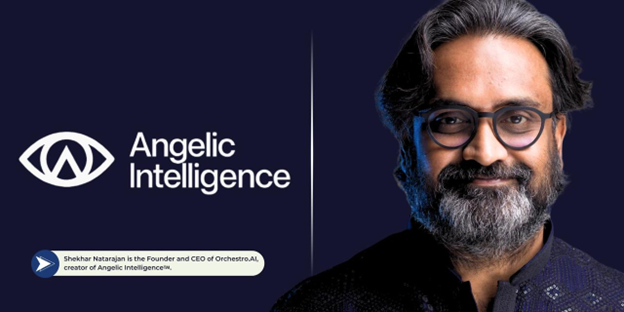
Shekhar Natarajan is the Founder and CEO of Orchestro.AI, creator of Angelic Intelligence . He delivered the opening keynote at Agentic AI Davos 2026, hosts Tomorrow, Today (#4 on Spotify), won the Signature Awards’ Global Impact prize, and holds 300+ patents with degrees from Georgia Tech, MIT, Harvard Business School, and IESE. He grew up in a one-room house in the slums of Hyderabad with no electricity. His father earned $1.75 a month delivering telegrams by bicycle. His mother stood outside a headmaster’s office for 365 days. He has one son, Vishnu, and paints every morning at 4 AM. He does not appear in the Epstein files.
If you have any objection to this press release content, kindly contact pr.error.rectification@gmail.com to notify us. We will respond and rectify the situation in the next 24 hours.